







Imposter fraud has grown from a nuisance into a sophisticated crisis, becoming one of the main culprits eroding trust in voice communications. To help enterprises understand the scale of this threat, Transaction Network Services (TNS) has released the results of new research in an eBook, Imposter Fraud Insights: The Growth in Impersonation Scams, providing critical data and statistics for understanding the full scope of the crisis.
Impersonation Fraud Costs Billions
According to the FTC, impersonation fraud is currently the second-largest type of fraud in the US, costing American citizens almost $3 billion annually. As part of our efforts to analyze and communicate the impact of imposter fraud calls, our eBook includes new survey data that affirms evolving consumer concerns. For example, 80% of Americans believe there has been an increase in imposter scams in 2025, while more than half (54%) say they know someone who has been a victim of an impersonation scam and lost money as a result.
As bad actors increasingly weaponize psychological tactics—such as familiarity, urgency, and fear—to manipulate victims, the need for a defense strategy that goes beyond traditional security measures has never been more urgent.
Consumers Concerned About AI Impersonation Fraud
The rapid evolution of generative AI has acted as an accelerant for consumer fear, creating a landscape where users are increasingly suspicious of answering calls from unknown numbers. Our data reveals that 77% of US adults are very concerned that AI technology could be used to convincingly impersonate their voice or identity to gain access to sensitive accounts, highlighting the urgent need to protect against AI voice cloning.
This anxiety hits close to home. Most people are acutely aware of the risk of so-called ‘grandparent scams’, with nearly two in three (64%) respondents saying they are very worried about imposters pretending to be them to scam members of their own family.
Despite the prevalence of these attacks, consumers remain willing to do their part: 84% say they are willing to go through a longer login or verification process if it reduces risk.
Bank Impersonation Scams and Risks to High-Touch Businesses
Financial institutions are a frequent target for bank impersonation scams, as fraudsters work to steal customers’ identities. Over one in three people (37%) say they received a scam call in the last year in which someone was impersonating one of their financial providers. Furthermore, nearly one in two (49%) Americans say they, or someone they know, have had their financial details fraudulently accessed by someone pretending to be a trusted organization.
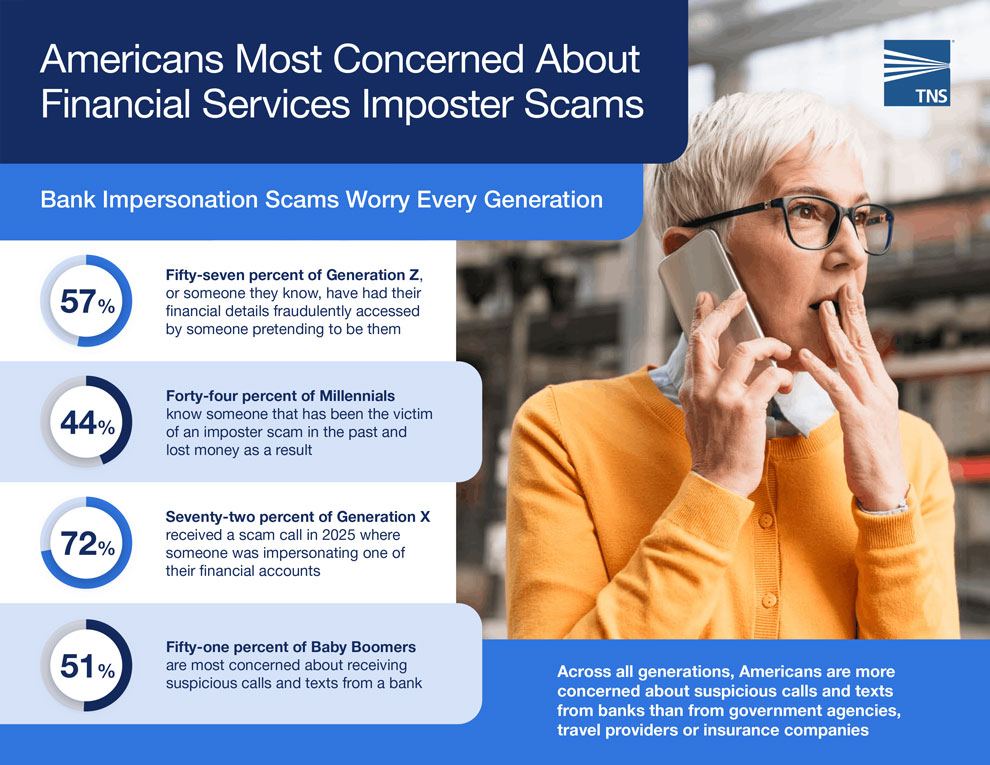
The ramifications of imposter scams for financial institutions are dire. The resulting loss of consumer trust can lead to customers switching to a competitor: 79% of adults would switch to a competitor if they found out their bank was not taking every available step to protect them.
Impersonation Fraud Targets Government Events
Bad actors also frequently target confusion surrounding major government events, such as this year’s government shutdown. In government scams, bad actors often impersonate agencies in calls and texts with the goal of stealing the victims’ funds. This year during the shutdown, bad actors posed as the US Supreme Court, peddling scams that were designed to appear legitimate, using official-looking documents, personalized victim details and urgent threats of legal consequences.
This example is not an isolated incident. Our survey data underscores how widespread these government impersonation scams have become, revealing that one-third (33%) of respondents received a scam call in 2025 in which someone was impersonating a government agent.
Impersonation Scams Within Industries
This threat extends to other high-touch industry verticals that rely on phone calls to communicate with their customers, including:
- Healthcare: 36% of Americans believe they, or someone they know, had their healthcare data fraudulently accessed.
- Retail: One in two US adults has discovered a retail purchase made in their name by an imposter.
- Hospitality: 48% of 25-34-year-olds have had a travel or hotel booking fraudulently altered.
Imposter Scam Concerns Vary By Demographics
While many assume the elderly are the primary targets, the data tells a different story. Impersonation scams are affecting every corner of the economy and every demographic.
Contrary to stereotypes, younger generations are currently at the highest risk. Forty-one percent of Gen Z reported being defrauded compared to just 24% of Baby Boomers.
However, a significant disparity exists between confidence and reality. While 34% of people admit they have been a victim and lost money, confidence remains high: 74% of men and 66% of women say they know what to do to prevent this type of imposter scam. Unfortunately, high consumer confidence is no longer enough. The sophisticated nature of AI-driven attacks creates a “protection gap” that individuals cannot bridge alone.
How Imposter Fraud Can be Tackled
As the telecom industry continues to battle against fraud, TNS is uniquely positioned to restore trust in the voice channel. The TNS Enterprise Product Suite helps impacted industries fight impersonation fraud through advanced technology that enhances the security of outbound voice communications:
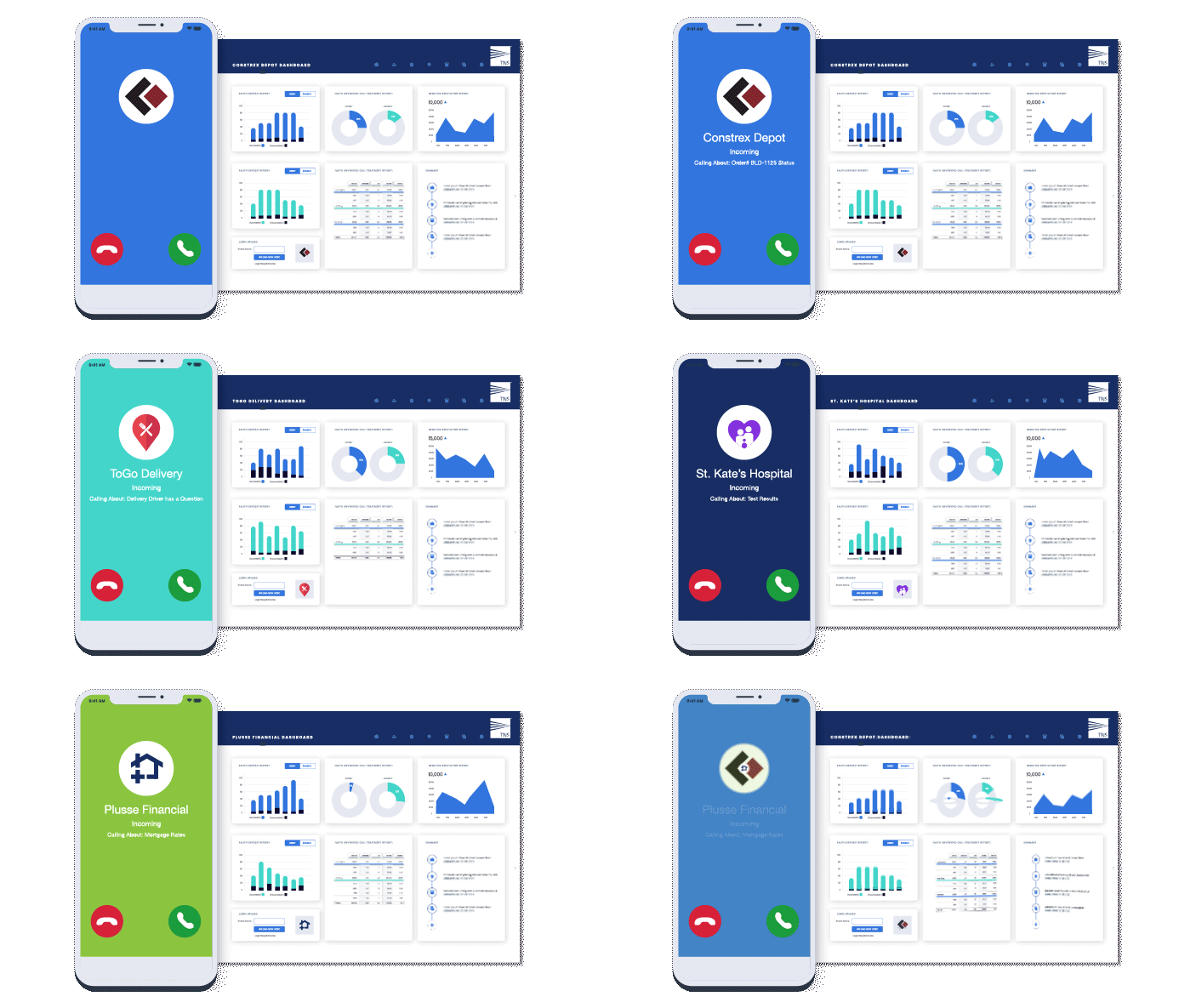
- TNS Enterprise Branded Calling: This allows organizations to provide rich branded caller information on the incoming call screen, empowering the receiver with the confidence to answer.
- TNS Enterprise Authentication and Spoof Protection: These tools leverage industry standards to authenticate calls and deliver legitimate, verified calls with branding to consumers, while blocking or labeling spoofed call attempts.
In one recent deployment, a leading US bank was able to block nearly 2,500 spoofed calls in the first week alone.
To see the full breakdown of data, industry impacts and strategies for protecting against fraud, download the Imposter Fraud Insights: The Growth in Impersonation Scams eBook.
Mike Schinnerer is Vice President of Enterprise Product Management at TNS with specific responsibility for TNS Communications Market.
Discover TNS’ Branded Calling and Enterprise Solutions
Learn how the TNS can help to improve your inbound and outbound calling operations and protect your business and customers