







Caller authentication confirms a caller’s identity before sharing sensitive data or completing transactions. In today’s phone-driven customer journeys, effective call authentication reduces fraud, restores trust in the voice channel and accelerates legitimate interactions.
Organizations that adopt caller authentication see lower fraud rates, higher answer rates for branded calls and more efficient call center authentication workflows.
What Is Caller Authentication?
Caller authentication verifies a person or enterprise’s identity, helping to prevent identity theft, support compliance and protect customer data. It also improves customer experience by reducing repeated ID checks and enables branded calling to boost answer rates and engagement.
A reliable caller authentication flow follows three stages: initiation, verification and decision.
- Initiation – captures call-origin data such as ANI or SIP headers.
- Verification – applies to one or more techniques – from passive caller ID verification to active IVR authentication or biometric checks.
- Decision – routes outcomes to acceptance, additional verification or escalation to an agent for manual review.
This layered approach balances security with smooth customer interactions.
Key Methods for Caller Authentication
With the outcome being the same – call authentication – there are various methods that achieve this. Below are some of the key methods:
- Caller ID and Caller ID Verification: Match the displayed number to records and use anti-spoofing signals to flag mismatches; effective as a quick, low-friction first check.
- STIR/SHAKEN and Branded Calling: Validate the originating carrier’s attestation and display verified caller information to recipients for increased trust.
- ANI and Caller ID Authentication: Use Automatic Number Identification alongside network-level checks to corroborate caller identity.
- IVR Authentication and Knowledge-Based Checks: Use IVR to collect PINs, one-time codes or dynamic KBA; effective for high-volume verification when paired with other signals.
- Biometric and Voice Verification: Use voiceprints or behavioral markers for repeat callers; effective against AI-driven impersonation when models stay current.
- Multi-Factor Approaches and Caller Verification Tokens: Combine something the caller knows (PIN), has (device token/one time passcode), and is (biometric) to significantly raise assurance levels.
- Advanced Voice Security: Enhance caller authentication with voice security tools that protect inbound calls through real-time alerting, blocking or redirection. What is STIR/SHAKEN for Caller Authentication?
STIR/SHAKEN provides a network-level attestation that a call legitimately originates from the stated number and carrier. When integrated with branded calling, it enables verified displays that show organization names and logos to call recipients.
For network carriers, adopting STIR/SHAKEN alongside call authentication processes, such as branded calling, helps to reduce spoofing and increase answer rates for trusted communications.
Caller Authentication Best Practices
1. Implementation Roadmap
To get the best results from call authentication, enterprises and call centers need a clear roadmap and caller authentication best practices.
- Assess risk and use cases: map high-risk call types (payments, account changes) to stronger verification requirements.
- Start with low-friction checks: implement caller ID verification, ANI matching, and zero trust policies to quickly reduce spoofed calls.
- Add progressive verification: introduce IVR authentication, OTPs or device tokens only when risk signals are present to limit friction.
- Integrate into agent workflows: surface verification results in the agent desktop and provide clear escalation steps for inconclusive calls.
- Enforce data controls: encrypt PII, limit biometric retention and log authentication events for auditability.
- Pilot and iterate: run controlled pilots, measure performance and expand successful flows across channels.
2. Operational Considerations
Caller authentication introduces trade-offs between security and user experience (UX), such as:
- Overly strict verification flows can lead to increased call abandonment and agent burden
- Accessibility must be considered for customers who cannot use voice biometrics or SMS for OTPs.
- Biometric systems require explicit consent, transparent retention policies, and careful handling to meet privacy expectations and regulations.
- Operational readiness includes agent training, incident response playbooks, and monitoring for evolving fraud tactics.
The right call center authentication solution will provide a space for both security and UX to coexist, verify caller ID and adhere to caller authentication best practices.
3. Metrics and Effectiveness
Call centers and enterprises using caller authentication should measure its impact on calling operations, though key metrics aren’t always obvious. TNS offers examples to help teams begin evaluating effectiveness:
- Authentication Success Rate: Percentage of calls that complete caller verification without escalation.
- Fraud Prevention Rate: Reduction in confirmed fraud incidents after caller verification deployment.
- Average Verification Time: Time added for caller authentication; target minimal impact on CSAT.
- False Rejection and False Acceptance Rates: Key biometric performance indicators to balance security and usability.
- Answer Rate Uplift for Branded Calling: Measure how verified displays affect pick-up rates.
- Escalation Volume and Agent Handling Time: Monitor operational costs of additional caller verification steps.
Caller Authentication: Next Steps
Enterprises and call centers can enhance caller authentication by layering caller ID verification, IVR authentication, OTPs and biometrics – balancing security with usability. A range of solutions are now available including TNS Enterprise Authentication and Spoof Protection as well as TNS Enterprise Voice Security.
Implementing caller authentication best practices – such as piloting high-risk interactions, tracking impact metrics and training agents on new workflows – strengthens both inbound and outbound call authentication. A strong caller authentication strategy reduces contact center fraud, boosts customer trust and improves efficiency.
Caller authentication remains a foundational control for any organization that relies on voice channels; start with caller ID verification and a clear roadmap to evolve into multi-factor and biometric solutions to protect customers and operations.
Maurie Munro is Vice President of Enterprise Sales at TNS with specific responsibility for the TNS Enterprise Product Suite.
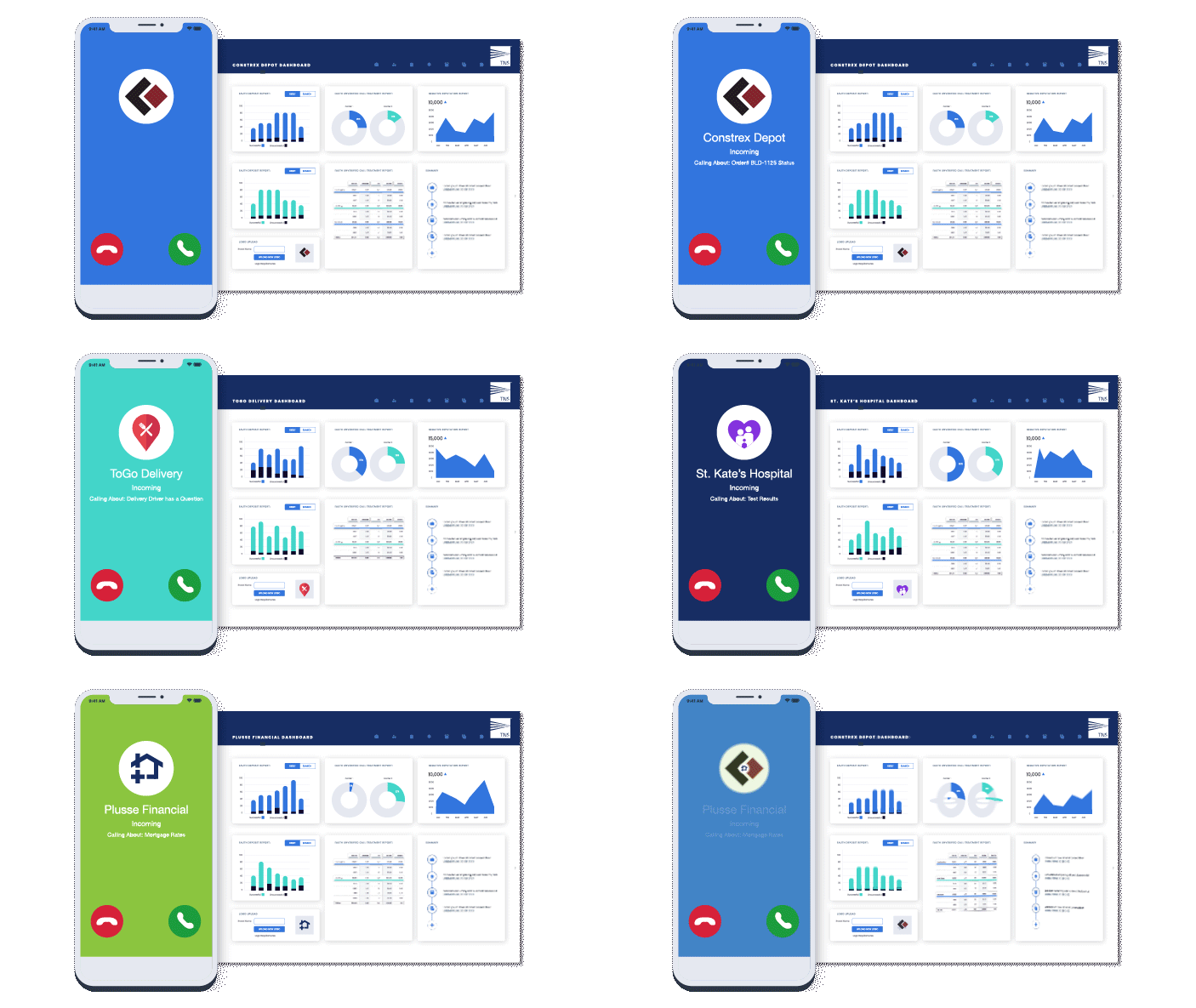
Discover TNS’ Branded Calling and Enterprise Solutions
Learn how TNS can help to improve your inbound and outbound calling operations and protect your business and customers.