











The multi-year battle to secure the voice channel and combat scam and spam robocalls has hit a wall, so to speak, between the haves and the have-nots. The nation’s top carriers, with sufficient budget and resources to invest in robocall mitigation efforts, continue to experience encouraging and tangible results.
Smaller and rural carriers, however, continue to balance network modernization from legacy switched TDM-to-SIP networks with financial realities. Combined with increasingly sophisticated voice fraud campaigns, these carriers are more exposed than ever to vulnerabilities that translate into persistent risks to their bottom lines, and subscribers.
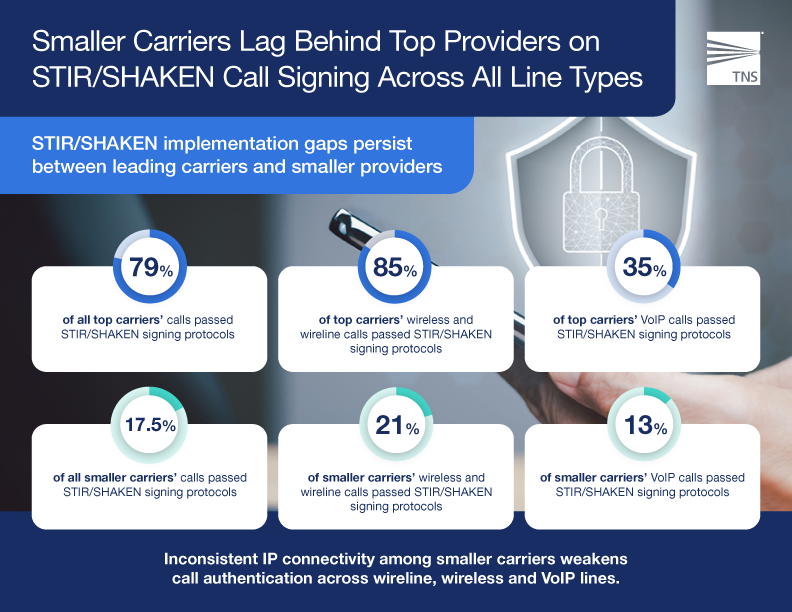
TNS’ 2026 Robocall Investigation Report reveals 85% of all voice traffic between Tier-1 carriers (Verizon, UScellular, T-Mobile, Lumen, Comcast, Charter and AT&T) was signed and verified with STIR/SHAKEN protocols in 2025 – 93% at the highest “A-level” attestation. The data tells a different story for smaller carriers, as the percentage of all signed call traffic between these providers was only 17.5% last year.
Continue Support For Regulatory Enforcement
All telco ecosystem stakeholders have a role to play in accelerating the transition away from TDM infrastructure and enacting regulatory measures that demand clearer accountability for carriers routing unsigned or suspicious call traffic as the industry works to further diminish unwanted robocall volume.
FCC rule proposals are advancing today, obligating carriers to upgrade or adopt alternative authentication. Increasing enforcement includes requirements for interrogating invalid numbers and blocking malformed traffic and the FCC has ramped up high-risk call controls by pushing aggregators and terminating carriers to focus on inspecting and blocking traffic.
Regulatory action is matched by efforts at the federal, state and local policy level, ranging from State Attorneys General “Operation Robocall Roundup” to Congress introducing The Foreign Robocall Elimination Act.
Expand Focus From Call Signing To Call Attestation
The STIR/SHAKEN framework has proven itself to facilitate signing, but it does not necessarily verify attestation legitimacy. In 2025, TNS observed the limitations of STIR/SHAKEN call signing protocols through improper attestation.
Improper attestation is a key metric our analysis flagged over the past several months. In 2025, up to 13% of traffic using invalid numbers were signed with “A” Attestation. More broadly, as much as 20% of overall signed traffic in some networks can exhibit over-attestation, where calls from “known invalid” or “Do-Not-Originate” (DNO) numbers are improperly validated.
For smaller carriers, this creates a two-part challenge: First, there remains a low volume of call traffic (17.5%) signed between these providers, let alone call traffic that is A-level attested. This lack of call signing translates into scammers exploiting attestation gaps by concealing robocall fraud campaigns in smaller carrier networks.
Tier-1 carriers are not immune from attestation issues, a problematic prospect given the far higher percentage of their call traffic signed with A-level attestation. One culprit is TDM bypasses, where roughly 40% of traffic lacks signatures. This makes tracking difficult and compromises traceback efforts.
Already prevalent in other countries, the validation trust problem is intensifying in the US as scammers misrepresent identities without inherent framework verification. SIM box campaigns are a prime example. In September of last year, the US Secret Service reported it had dismantled a sprawling SIM farm network that could be used to disrupt telecommunications service and shut down mobile networks.
SIM farm operations are anchored by SIM boxes that enable the remote management of massive traffic volumes and are often used to disguise international calls as local traffic. Our data estimates upwards of 15% of spam-tagged calls were linked to SIM farm operations, exploiting complexities within Mobile Virtual Network Operators (MVNOs).
Even strong call signing numbers for top carriers and all of the investments made to get to this point can be undermined without a robust post-STIR/SHAKEN strategy that incorporates advanced analytics engines able to deliver essential reputation scoring and blocking, as well as Know Your Customer (KYC) capabilities that offer deeper visibility into call signature information.
Invest in AI, Cloud To Deliver Secure Subscriber Experience
TNS survey data reveals more than half (54%) of Americans personally know someone who has lost money to an imposter scam, and more than three-quarters (77%) of US adults say they are very concerned AI technology can be used to convincingly impersonate their voice or identity to access sensitive accounts.
To combat AI threats, carriers must continue to invest in proven, innovative technologies – as well as their own people. This means leveraging AI applications such as voice biometrics, predictive AI-powered call analytics, and AI SMS detection. One example would be combining STIR/SHAKEN data with call analytics platforms and AI-powered call detection to allow carriers to better identify suspicious call patterns tied to SIM Box use – such as rapid SIM cycling or abnormal traffic spikes – and block them before they reach consumers.
John Haraburda is Product Lead for TNS Call Guardian® with specific responsibilities for TNS’ Communications Market solutions.
TNS 2026 Robocall Investigation Report
Request your copy of our industry defining and FCC cited Robocall Investigation Report. Our Report for 2026 highlights new robocall insights and trends to inform carriers, regulators, policymakers and the telecom industry on what to expect in 2026.